


Cable Puller — Pro Edition
Cable Puller — Pro Edition
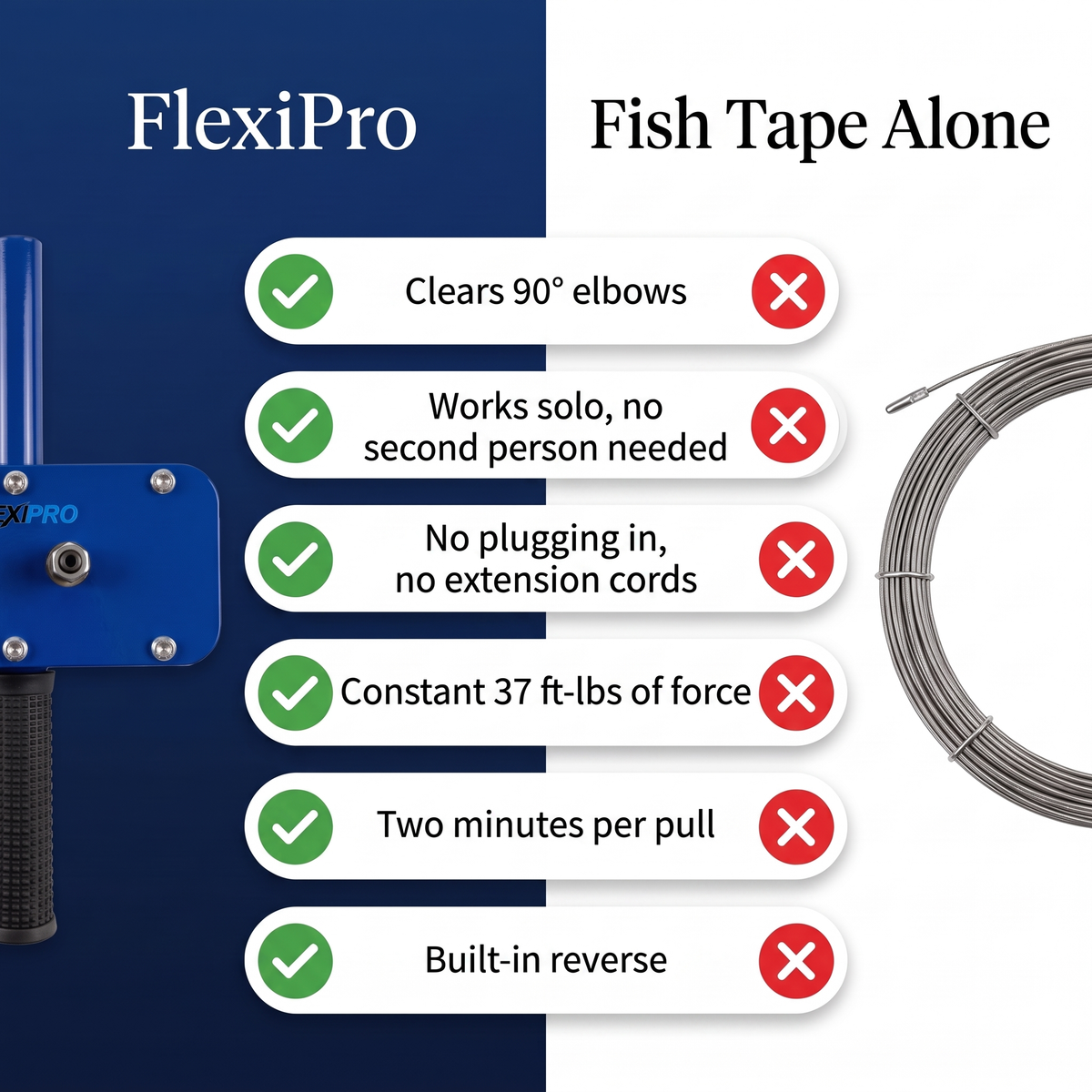
✅ Clears 90° elbows on the first try
✅ Saves time on every job
✅ 2 minutes per pull
Couldn't load pickup availability


Cable Puller — Pro Edition
7-Day Customer Support
7-Day Customer Support
Our team is here to answer your questions, 7 days a week.
You can reach us by email during the following hours: 9am to 5pm, Monday to Sunday.
contact@flexipro-tools.com
Don't hesitate to reach out.
Shipping Information
Shipping Information
Temporarily Out of Stock — But We're Back Very Soon!
FlexiPro is in such high demand that we're currently out of stock. We're restocking now, with availability expected by late September 2026.
📦 As soon as stock arrives, orders ship within 24h via local carrier
🚚 Delivery: 5 to 9 days maximum
⚠️ Good to know: every time we restock, inventory sells out fast — it's common for stock to run out again just days after going back online.
Our advice: order now to be served first as soon as stock arrives. You won't pay extra for waiting — your order is simply processed as soon as the product is available.


Cable Puller — Pro Edition, built tougher, stronger performance
Reinforced drive, tougher chassis, new roller system that accepts every diameter from 1/8" to 5/16".
What makes it different: you feed in a fish tape, or you insert the cable directly into the tool. One step instead of two.
90° elbows clear on the first try. No lubricant, no shop vac, no second person. Two minutes instead of thirty — and it's the drill doing the pushing, not your back.
You'll never hesitate before starting a pull again.
The FlexiPro community speaks

Office drop ceiling job, had to run an emergency cable between two rooms. Fixed it in 10 minutes without pulling down half the tiles.

Emergency panel repair, had to fish a cable through fast. With just a fish tape it would've taken a while. This had it done in 5 minutes — the customer didn't even have time to get impatient.

Ordered Monday, received Friday. Well packaged, the tool feels heavy and solid in hand. Works with my existing fish tape, didn't have to buy anything new.

40 feet with four bends in a drop ceiling, kept jamming at the same spot every time. The thing is the force comes from the conduit entrance, not the tip. That changes everything.

Twenty-two years fighting with conduits. Thought that's just how the job was. Now it's the tool doing the pushing, not my arms — I go home without my back wrecked.

It never leaves the truck anymore. Two years of getting by with a shop vac and lubricant — don't need any of that now. Only knock: I wish it came with a case."

22 years in the trade. Honestly wasn't fully convinced. I was wrong.

The photo says it all: my fish tape stayed on the floor. Stopped fighting with pliers and burning through lubricant for nothing. Only knock: I wish it came with a case.

Got it in 4 days. Took it out of the box, tried it the next day on a job with four bends. Cleared it on the first try. Nothing else to buy, works with my fish tapes.

Office job, drop ceiling, 40 feet with 4 bends. Kept jamming at the same spot with the fish tape. This time it went through. A bit heavy holding it overhead, but it gets the job done.
Why waste an hour on tricks when a cable can go through in two minutes?
FAQ
What if it doesn't work for me?
What if it doesn't work for me?
You have 30 days to try it on your jobs. If it's not a fit, we'll refund you in full, no questions asked.
Is it built for daily use?
Is it built for daily use?
Yes. Anodized aluminum chassis, reinforced drive, rollers built for heavy-duty professional use. It's made to live in the truck and go out every day.
Does it work in conduits that are already occupied?
Does it work in conduits that are already occupied?
Yes. The push is steady and continuous, which keeps the fish tape from spiraling and wrapping around existing conductors. This is a very common issue in renovation and low-voltage work.
What length can it handle?
What length can it handle?
No distance limit. The drill delivers constant force from the first foot to the last — it doesn't lose power the way a manual pull does with every foot and every bend.
What if the fish tape gets stuck along the way?
What if the fish tape gets stuck along the way?
Reverse is built in. Just switch the drill's rotation direction and the fish tape backs out immediately, with no forcing and no risk of bending it.
Can I pull cable on my own?
Can I pull cable on my own?
Yes. The drill does the pushing, not your arms — you no longer need someone on the other end. No more calling a coworker, no more waiting, no more owing anyone a favor.
Do I need a specific drill?
Do I need a specific drill?
No, any cordless drill works. No cords, no extension leads, no hunting for an outlet on site — the battery you already have is enough.
Does it work with my fish tape?
Does it work with my fish tape?
Yes. FlexiPro accepts all standard fish tapes and cables from 1/8" to 5/16", no adjustment or adapter needed. You keep what's already in the truck — nothing else to buy.
Does it really clear 90° elbows?
Does it really clear 90° elbows?
Yes, that's exactly what it was built for. The force is applied directly at the conduit entrance, not at the tip of the fish tape — so it arrives at the bend at full strength instead of losing power to friction along the way. Tight bends, multiple bends in a row, old installations: it clears them.
Can I insert the cable directly, without a fish tape?
Can I insert the cable directly, without a fish tape?
Yes, that's what makes this tool different. Depending on the setup, you either feed in a fish tape to prep the path, or insert the cable directly and push it straight through. One step instead of two.